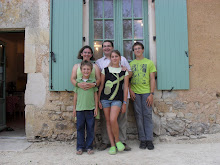
In England 2002 was the Golden Jubilee year of Queen Elizabeth II. At school there were lots of projects about the monarchy and free flags were handed out to all the children. Flags were everywhere, whcih is rare in England, on t-shirts, hanging from bedroom windows and tied to car radio masts. You couldn't help but feel English. For The Queen’s Silver Jubilee in 1977 communities had organized street parties and local fetes. I was ten then and remembered it well. This year we had a national holiday and so we went to my parents house in Nottingham. They live on a quiet surburban housing estate and the surrounding homes had planned a small street party. Each family had to bring their own food for a lunch, and we would share the cost of a bouncy castle and fireworks at dusk.
This is one time when one should feel patriotic but somehow I just couldn’t feel as enthusiastic about it as I had twenty-five years ago. Luckily Marc and Nina were excited and we dressed them up as an English Saint George Knight and English Princess, in white with English red crosses, for the day. Jacques, unlike me in France on his national holiday, was ambivalent and somewhat bored by the preparations. However he took on the lunch and made some interesting salads and a quiche for us to share and he bought some good wine too.
My dad was not so impressed by the salads and quiche and remarked that we should be eating something more ‘English’, making me snappy and angry on Jacques behalf. What did he want? Ham sandwiches and boiled eggs with a cup of tea? I said nothing because I too had cravings for English picnic food, but then Jacques had made such beautiful (and healthy) salads it would be mean to moan. And I felt Jacques contribution was important and I wanted him to feel part of the day too, not excluded. As the party started I still felt strangely distant and unable to really get into it. I felt like a foreigner too in my own country. The kids loved the day though and we did have an excellent weekend, but I couldn’t help feel that I would have been more enthusiastic if it had been in France….why was that? Had I abandoned my English heritage already? Didn’t my children need to know about important English national days as well? How do you balance two cultures?
Wednesday, November 22, 2006

Tuesday, November 21, 2006
Spotless Translation.
We decided to go to France for the Easter holidays, to see the family and also try to top up Nina’s French level. We planned to be there for their cousins Francois’ 6th birthday. Being a bilingual family means we don’t often attend family birthdays and the times when we can be there are very special. We were there for the special ones though, we went back for both grandmothers 60th birthdays and my father came down to us in London for his 65th birthday. We happened to be around once for grandpère and a few times for my mum, who has a summer birthday. So this was a real delight for us to be there.
The party was simple; Gaelle, Phillipe and their three children, Gaelle’s parents, her in-laws and us. Francois blew the six candles on his cake, that Odile had made, and we sang ‘Happy Birthday’ in French and he opened a few gifts. Four-year-old Manon was off-colour that day, looking feverish and sick. I asked what was wrong. Gaelle replied in French ‘ Elle a la varicelle.’ ‘Varicelle’? I wondered what it was. Hours of French at school had given me only a limited vocabulary and I had never really come across many medical terms apart from the basics like blood, fever, sickness etc. So Jacques translated it as ‘measles’. It looked right since she had red spots on her body and was hot. I never had measles as a child, but it certainly looked like the spotty childhood disease you read about in books. I knew that Gaelle had not done all the vaccinations for her children because she didn’t want them to have unnecessary medicines. No need to worry, I thought, Nina was vaccinated for measles as a baby.
A few weeks later, back in London, we celebrated another birthday – Nina’s 3rd. We were blessed to have a full house for her tea-party, my parents were visiting, along with Jacques’ mother and Jacques’ godmother, Claude. We sat down to a beautiful chocolate and strawberry cake, that Jacques had made for Nina. But Nina was in a bad mood, didn’t want to blow the candles or sing. She was hot and flushed and clung to my mother. When I lifted her dress to change her I saw spots on her tummy…..red spots. Next morning it was worse she was burning up and itching all over. I angrily told the doctor she had already had the measles vaccination, so how could she have got the measles? ‘But no,’ the doctor replied ‘She’s got chicken pox! Don’t you know the difference?’ Humiliated I left with a prescription for itching and called Jacques. ‘I thought you said Manon had measles! She had chicken pox!’ I said. ‘If I’d known it was chicken pox I would have been ready for her to come out in spots!’ Ah well…..the mistranslation was done and so poor Nina suffered like her cousin Manon, and two weeks later, on the dot, Marc came down with chicken pox too…and by the way measles is rougeole for any French/English families reading this!
The party was simple; Gaelle, Phillipe and their three children, Gaelle’s parents, her in-laws and us. Francois blew the six candles on his cake, that Odile had made, and we sang ‘Happy Birthday’ in French and he opened a few gifts. Four-year-old Manon was off-colour that day, looking feverish and sick. I asked what was wrong. Gaelle replied in French ‘ Elle a la varicelle.’ ‘Varicelle’? I wondered what it was. Hours of French at school had given me only a limited vocabulary and I had never really come across many medical terms apart from the basics like blood, fever, sickness etc. So Jacques translated it as ‘measles’. It looked right since she had red spots on her body and was hot. I never had measles as a child, but it certainly looked like the spotty childhood disease you read about in books. I knew that Gaelle had not done all the vaccinations for her children because she didn’t want them to have unnecessary medicines. No need to worry, I thought, Nina was vaccinated for measles as a baby.
A few weeks later, back in London, we celebrated another birthday – Nina’s 3rd. We were blessed to have a full house for her tea-party, my parents were visiting, along with Jacques’ mother and Jacques’ godmother, Claude. We sat down to a beautiful chocolate and strawberry cake, that Jacques had made for Nina. But Nina was in a bad mood, didn’t want to blow the candles or sing. She was hot and flushed and clung to my mother. When I lifted her dress to change her I saw spots on her tummy…..red spots. Next morning it was worse she was burning up and itching all over. I angrily told the doctor she had already had the measles vaccination, so how could she have got the measles? ‘But no,’ the doctor replied ‘She’s got chicken pox! Don’t you know the difference?’ Humiliated I left with a prescription for itching and called Jacques. ‘I thought you said Manon had measles! She had chicken pox!’ I said. ‘If I’d known it was chicken pox I would have been ready for her to come out in spots!’ Ah well…..the mistranslation was done and so poor Nina suffered like her cousin Manon, and two weeks later, on the dot, Marc came down with chicken pox too…and by the way measles is rougeole for any French/English families reading this!
Thursday, November 02, 2006
Trying to fit in
In January 2002 it was Marc’s 5th birthday, and he wanted to invite all his friends. Jacques said that in France you would just invite a few kids round for a tea or gouter, but in England kids birthday parties are important events. Not wanting him to feel left out we hired a sports hall and invited all the class. They jumped on the bouncy castle, ran around madly and then wolfed down chicken nuggets and chips with ice cream in the cafe. The birthday cake was brought in, we all sang ‘Happy Birthday’ and Marc blew the candles out, but we did not eat the cake. The kids lined up for their ‘party bag’ gift, and a slice of the cake wrapped in a paper napkin to take home with them. Before they all left Jacques insisted that Marc open his gifts in front of his friends, something not always done at English parties. Marc did so with a genuine happiness to receive each present, and thanked each child properly. But I still had to send out personalized thank-you cards a few days later anyway as one does in England….
I was into a good work rhythm researching and writing my book on one-parent-one language families. I had the luxury of my evening classes on Linguistics and the Birkbeck Library in London to escape to (on the two days I had my babysitter) and the book was progressing nicely. Once or twice a month I would take a work-break and do some volunteering. Nina’s pre-school invited one mother to help out every day once a term. I liked this system, it seemed fair and the teachers were friendly and chatty. At the Wednesday church playgroup I attended with Nina I did my craft rota or helped tidy away the toys. In Marc’s school I did some reading practice, school trips and for big fundraisers, like summer fetes, I would man a stall or help do face-painting. But no matter how much I tried I was never really accepted in the various communities.
People would ask me where I had lived before and I would vaguely say ‘France..’, to which they would either be stunned into silence or chat about their parents/brother/cousin who bought a cheap property in France and did it up…Other mothers would ask me about my unusual surname. It seemed that there was a big difference to 1995 when having a French boyfriend was rather sexy and clever. But seven years on as a French/English family people wondered how could I be married to a Frenchman? On top of that we were renting a small flat, when most families in that area owned their houses. We had a tiny 10-year-old Peugeot 206, which looked like a toy compared to most mother’s family cars. My close friends and family were able to look beyond the material possessions, of course, but in general I often felt excluded or somehow not English any more. But then again I didn’t feel 100% English either, and often felt I was looking at my own country with the eyes of a foreigner. No wonder the other mothers didn’t know how to place me.
My saviour was Helen, who I met while researching the OPOL book. Helen was a mix of English and Norwegian parentage and married to a Frenchman. They had lived in London a few years and before that in Switzerland, like us. Our children were of a similar age and at last I was able to talk to someone who truly understood the reality of being married to a Frenchman, but living in England. Helen spoke excellent French and loved France and her family, which she often visited. Both our husbands liked working in England and enjoyed English comedies and cinema. Over lunch we would discuss the problems of choosing schools, helping your children to fit in and keeping languages strong and alive. When we got together the kids would speak mostly English together, but we would hear French mixed into sentences.
Helen and I were both struggling to keep the French alive in a very monolingual environment. Our children were too young to study French at school (which would have been for beginners anyway) so the French mainly came from Papa. But living and working in England had made English the dominant language. So dominant that when I calculated how much French my kids spoke these days it was only about 20%. My research on Language Shift, and the inevitable Language Death which follows if no action is taken alarmed me. At home books, television, videos, games were in the majority in English. And then one day, with amazement, I listened to Jacques asking Nina a question in French and she replied in English. He accepted it and they continued what they were doing as if nothing strange had happened…..
I was into a good work rhythm researching and writing my book on one-parent-one language families. I had the luxury of my evening classes on Linguistics and the Birkbeck Library in London to escape to (on the two days I had my babysitter) and the book was progressing nicely. Once or twice a month I would take a work-break and do some volunteering. Nina’s pre-school invited one mother to help out every day once a term. I liked this system, it seemed fair and the teachers were friendly and chatty. At the Wednesday church playgroup I attended with Nina I did my craft rota or helped tidy away the toys. In Marc’s school I did some reading practice, school trips and for big fundraisers, like summer fetes, I would man a stall or help do face-painting. But no matter how much I tried I was never really accepted in the various communities.
People would ask me where I had lived before and I would vaguely say ‘France..’, to which they would either be stunned into silence or chat about their parents/brother/cousin who bought a cheap property in France and did it up…Other mothers would ask me about my unusual surname. It seemed that there was a big difference to 1995 when having a French boyfriend was rather sexy and clever. But seven years on as a French/English family people wondered how could I be married to a Frenchman? On top of that we were renting a small flat, when most families in that area owned their houses. We had a tiny 10-year-old Peugeot 206, which looked like a toy compared to most mother’s family cars. My close friends and family were able to look beyond the material possessions, of course, but in general I often felt excluded or somehow not English any more. But then again I didn’t feel 100% English either, and often felt I was looking at my own country with the eyes of a foreigner. No wonder the other mothers didn’t know how to place me.
My saviour was Helen, who I met while researching the OPOL book. Helen was a mix of English and Norwegian parentage and married to a Frenchman. They had lived in London a few years and before that in Switzerland, like us. Our children were of a similar age and at last I was able to talk to someone who truly understood the reality of being married to a Frenchman, but living in England. Helen spoke excellent French and loved France and her family, which she often visited. Both our husbands liked working in England and enjoyed English comedies and cinema. Over lunch we would discuss the problems of choosing schools, helping your children to fit in and keeping languages strong and alive. When we got together the kids would speak mostly English together, but we would hear French mixed into sentences.
Helen and I were both struggling to keep the French alive in a very monolingual environment. Our children were too young to study French at school (which would have been for beginners anyway) so the French mainly came from Papa. But living and working in England had made English the dominant language. So dominant that when I calculated how much French my kids spoke these days it was only about 20%. My research on Language Shift, and the inevitable Language Death which follows if no action is taken alarmed me. At home books, television, videos, games were in the majority in English. And then one day, with amazement, I listened to Jacques asking Nina a question in French and she replied in English. He accepted it and they continued what they were doing as if nothing strange had happened…..
Wednesday, November 01, 2006
He might be hyper-active…
The Reception year at Chorleywood Primary School was a very masculine class – over 20 boys and a handful of girls. The girls settled down with worksheets and practiced writing while the boys tore around role-playing cowboys and dragon-killers. I discovered from other mothers that the Reception year was not the gentle lead-in to school it was supposed to be, but the first crucial year of school. In Year 2 (around age 7) the class would sit the British national SATS test, which would affect the rating of the school. To pass these tests in two years time the children needed to be ‘fluent’ readers, and progress was slow. I went in to help out with the reading every two weeks. Some kids could whiz through a book, while others could barely pick out a familiar sentence. But these kids were only four years old, and they looked so young in their brand-new gray and burgundy school uniforms.
Reports were sent out in the first term, and Jacques and I had our first ever parent-teacher meeting. We waited nervously outside the classroom, looking at some of Marc’s work and wondering what we were supposed to say. ‘I’ve done the baseline Reception tests and Marc is well below average with his language.’ Mrs. Lund said sadly. She went on to explain that Marc had problems with pronouncing ‘y’ and ‘sh’ and was very distracted in class. He couldn’t write his name ‘properly’ or do the writing worksheets. He might even be ‘hyper-active’ she added and was ‘socially immature’. We tried to explain that he had two languages at home, had come from at French pre-school and recently moved house. The teacher looked really worried, as if it hadn’t occurred to her that Jacques was French or that we might actually speak French at home. She suggested a Speech Therapist, and although she didn’t say ‘Drop the French!’ she was probably thinking it. Jacques said he would like a proper psychologist to test Marc for hyper-activity and Mrs. Lund promptly downgraded him to ‘active’, and assured us there was no need for that kind of intervention yet. We left feeling very unsettled about the meeting and what exactly was wrong with Marc. It seemed like he was not up to standard.
The British educational system favours the ‘average’ child. Bright kids are bored and held back in class. Slow kids who need extra help, and those with learning problems or dyslexia, are quickly diagnosed in Reception, but the parents must lobby for external tutoring or in-class assistance. But Marc didn’t have any real problems; he was simply not ready to settle into academic life, like several of his boy peers. The boys were into Lego, Mechano, making train sets and building castles with boxes. They communicated with actions not language. Writing, reading and copying letters did nothing for them. If he had stayed in the French system he would have been allowed to play more, because academic reading and writing starts at age six, in the CP class. But we had made our choice and we must stick with it. Most days Marc was happy to go to school and had several good friends. After-school he would go to play or invite his friends to our house. I became good friends too with the mothers of George, Louis, Ewan, Joshua and Sam and we had fun birthday parties and get-togethers.
We decided to stay in England for Christmas and invited my parents and my sister for Christmas Day. Over the last five years of being a family we had alternated Christmas in France and England. But I was frustrated by the French families lack of decorations, emphasis on the 24th rather the 25th and putting out slippers instead of socks for Santa. Jacques was also keen to do our own thing rather than expect the in-laws to do everything for us. My birthday is on the 25th December too, and I was feeling embarrassed that my mum, or Odile, were making a birthday cake for me, and I thought the kids could take over that part. This year the children were old enough to participate and it was time to create our ‘own’ Christmas. We decorated the house and tree early in December and indulged in all the carols, pantomimes and Santa-visits we could find. It felt great to be in England and I realized how much I loved December. But as the 25th approached Jacques refused to buy a turkey. Why not? I protested. He said the turkey was over-priced (true) and was so dry when it was cooked it didn’t impress him. After much heated discussion we settled on a turkey and cranberry sauce starter, followed by fish then a leg of lamb cooked by Jacques. I refused to drop the traditional English Christmas pudding with brandy sauce and brandy butter. It was wonderful to do our own Christmas though, on the day the children were truly amazed to find their gifts, which Santa had left a la française on top of their slippers… and later on in the day the children prepared my birthday cake and helped make an afternoon tea. My parents and sister didn't mention the lack of turkey and had a good time seeing Christmas through Marc and Nina's eyes, albeit with a slightly French flavour...
Reports were sent out in the first term, and Jacques and I had our first ever parent-teacher meeting. We waited nervously outside the classroom, looking at some of Marc’s work and wondering what we were supposed to say. ‘I’ve done the baseline Reception tests and Marc is well below average with his language.’ Mrs. Lund said sadly. She went on to explain that Marc had problems with pronouncing ‘y’ and ‘sh’ and was very distracted in class. He couldn’t write his name ‘properly’ or do the writing worksheets. He might even be ‘hyper-active’ she added and was ‘socially immature’. We tried to explain that he had two languages at home, had come from at French pre-school and recently moved house. The teacher looked really worried, as if it hadn’t occurred to her that Jacques was French or that we might actually speak French at home. She suggested a Speech Therapist, and although she didn’t say ‘Drop the French!’ she was probably thinking it. Jacques said he would like a proper psychologist to test Marc for hyper-activity and Mrs. Lund promptly downgraded him to ‘active’, and assured us there was no need for that kind of intervention yet. We left feeling very unsettled about the meeting and what exactly was wrong with Marc. It seemed like he was not up to standard.
The British educational system favours the ‘average’ child. Bright kids are bored and held back in class. Slow kids who need extra help, and those with learning problems or dyslexia, are quickly diagnosed in Reception, but the parents must lobby for external tutoring or in-class assistance. But Marc didn’t have any real problems; he was simply not ready to settle into academic life, like several of his boy peers. The boys were into Lego, Mechano, making train sets and building castles with boxes. They communicated with actions not language. Writing, reading and copying letters did nothing for them. If he had stayed in the French system he would have been allowed to play more, because academic reading and writing starts at age six, in the CP class. But we had made our choice and we must stick with it. Most days Marc was happy to go to school and had several good friends. After-school he would go to play or invite his friends to our house. I became good friends too with the mothers of George, Louis, Ewan, Joshua and Sam and we had fun birthday parties and get-togethers.
We decided to stay in England for Christmas and invited my parents and my sister for Christmas Day. Over the last five years of being a family we had alternated Christmas in France and England. But I was frustrated by the French families lack of decorations, emphasis on the 24th rather the 25th and putting out slippers instead of socks for Santa. Jacques was also keen to do our own thing rather than expect the in-laws to do everything for us. My birthday is on the 25th December too, and I was feeling embarrassed that my mum, or Odile, were making a birthday cake for me, and I thought the kids could take over that part. This year the children were old enough to participate and it was time to create our ‘own’ Christmas. We decorated the house and tree early in December and indulged in all the carols, pantomimes and Santa-visits we could find. It felt great to be in England and I realized how much I loved December. But as the 25th approached Jacques refused to buy a turkey. Why not? I protested. He said the turkey was over-priced (true) and was so dry when it was cooked it didn’t impress him. After much heated discussion we settled on a turkey and cranberry sauce starter, followed by fish then a leg of lamb cooked by Jacques. I refused to drop the traditional English Christmas pudding with brandy sauce and brandy butter. It was wonderful to do our own Christmas though, on the day the children were truly amazed to find their gifts, which Santa had left a la française on top of their slippers… and later on in the day the children prepared my birthday cake and helped make an afternoon tea. My parents and sister didn't mention the lack of turkey and had a good time seeing Christmas through Marc and Nina's eyes, albeit with a slightly French flavour...
Friday, October 27, 2006
You’re too late…..
Moving back to England was like a reverse culture shock, even though it is my country and Jacques loved it before. Everything seemed more expensive than five years ago and I felt lost, bewildered and out-of touch with my peer group . Our budget was barely enough to rent a one-bedroomed studio in central London. I looked around the dreary suburbs around London where I’d lived after graduation, but couldn’t imagine living there with young kids. In 1995 (before the children were born) we had lived briefly in Gerrards Cross, a green enclave at the edge of Greater London. I remembered that schools were good around there and it was near to two airports, so focused on the nearby small towns, which had train connections to central London. I felt like a foreigner in my own country and estate agents found it odd we didn’t want to buy a house, as most English families do.
I looked for ‘good’ schools with places available, but the Education Office said they could not say if they had a place until I was living in their catchment area. Fair enough, but I needed to know if it was worth moving into the area. When I telephoned the school offices directly with the opening lines ‘We are a new family who has just moved into the area…’ I was rudely cut off with the information that I should have applied nine months ago and all classes were full now. It was too late now, and all they could do was squeeze Marc into some (probably awful) school that might not even be in my area…
In panic-mode I signed a lease on a basic three-bedroomed Seventies flat or apartment in Chorleywood. It was a green and pleasant village-town near to a station and shops, and had three ‘good’ schools. I telephoned the schools; one was over-booked already, the other was a church school (no chance as you must attend the attached church for two years and have a letter of recommendation from the church) and the third said “Let me see…’ After a few days the secretary rang back and said ‘You are so lucky, a family is emigrating to Australia and you can have their place.’ I visited the Headmaster immediately to explain our delayed application and we were in! Marc was officially admitted to the Nursery class of Chorleywood Primary School, starting just after the Easter holidays. The school had busy colourful classrooms and lots of happy children running around the grassy playground at playtime.
Next I concentrated on Nina. As a two-year-old she was too young for the Nursery class, which started just before the fourth birthday. The best option was a full-day Pre-school or private childcare. These options were no good either. The pre-schools would not accept her until she was 2 ½ (and they were only half-day anyway). The full-time childcare center and the local childminders were full, presumably pre-booked at birth. I wished that I was in France, where she would have had a full-time school place at age two-and-a half.
We moved our things to the new apartment with little enthusiasm. The flat was uninspiring and we felt out of place. I left the children with my parents for a few weeks while I started work. I soon realized the commute was nearly 2 hours a day and I would not be home before 6.30pm, even on a good day. An au-pair from France would have been ideal, but we had no spare room. Jacques’ mother came to help out with childcare temporarily. But after a month we had no choice and had to hire a nanny. Several potential nannies visited and said no straightaway. They were used to their own car, huge playrooms/gardens and lots of perks. So we were obliged to hire a first-time Nanny from Australia who didn’t know any better.
Kylie was to drop off/pick-up Marc at school and mind Nina all day. She came with her son, who was the same age as Nina. She cost the same salary as me. She refused to do any housework and would only prepare simple food for the kids. We tried it out for a few months, but it was not a success. So we stopped the Nanny and struggled through the summer with help of my sister-in-law, parents and Jacques parents looking after the kids.
Even though I liked working I missed the school drop-offs and pick-ups (when all the mothers got together to chat). I missed the Assemblies and Sports days. I hated the stress of being home on time and trying to compensate afterwards with kids before they went to bed. In September when Marc was due to start Reception – the first year of Primary school, I reduced my hours to three days a week and had a Caribbean woman, Lydia, look after the kids the other days. But by October I gave up working. It was not worth it. I enrolled for an evening PhD course in Linguistics at Birkbeck College and signed Nina up for the local pre-school four mornings a week.
I calculated that I would have 12 hours for working at home in the mornings and two afternoons when Lydia picked up the kids for my study classes at Birkbeck. In the evenings I could work for up to three hours when the kids were in bed too. The housework, coffee-mornings and watching television would have to be postponed but I could get my PhD papers done and write the book I had always wanted to, if I really tried…..
I looked for ‘good’ schools with places available, but the Education Office said they could not say if they had a place until I was living in their catchment area. Fair enough, but I needed to know if it was worth moving into the area. When I telephoned the school offices directly with the opening lines ‘We are a new family who has just moved into the area…’ I was rudely cut off with the information that I should have applied nine months ago and all classes were full now. It was too late now, and all they could do was squeeze Marc into some (probably awful) school that might not even be in my area…
In panic-mode I signed a lease on a basic three-bedroomed Seventies flat or apartment in Chorleywood. It was a green and pleasant village-town near to a station and shops, and had three ‘good’ schools. I telephoned the schools; one was over-booked already, the other was a church school (no chance as you must attend the attached church for two years and have a letter of recommendation from the church) and the third said “Let me see…’ After a few days the secretary rang back and said ‘You are so lucky, a family is emigrating to Australia and you can have their place.’ I visited the Headmaster immediately to explain our delayed application and we were in! Marc was officially admitted to the Nursery class of Chorleywood Primary School, starting just after the Easter holidays. The school had busy colourful classrooms and lots of happy children running around the grassy playground at playtime.
Next I concentrated on Nina. As a two-year-old she was too young for the Nursery class, which started just before the fourth birthday. The best option was a full-day Pre-school or private childcare. These options were no good either. The pre-schools would not accept her until she was 2 ½ (and they were only half-day anyway). The full-time childcare center and the local childminders were full, presumably pre-booked at birth. I wished that I was in France, where she would have had a full-time school place at age two-and-a half.
We moved our things to the new apartment with little enthusiasm. The flat was uninspiring and we felt out of place. I left the children with my parents for a few weeks while I started work. I soon realized the commute was nearly 2 hours a day and I would not be home before 6.30pm, even on a good day. An au-pair from France would have been ideal, but we had no spare room. Jacques’ mother came to help out with childcare temporarily. But after a month we had no choice and had to hire a nanny. Several potential nannies visited and said no straightaway. They were used to their own car, huge playrooms/gardens and lots of perks. So we were obliged to hire a first-time Nanny from Australia who didn’t know any better.
Kylie was to drop off/pick-up Marc at school and mind Nina all day. She came with her son, who was the same age as Nina. She cost the same salary as me. She refused to do any housework and would only prepare simple food for the kids. We tried it out for a few months, but it was not a success. So we stopped the Nanny and struggled through the summer with help of my sister-in-law, parents and Jacques parents looking after the kids.
Even though I liked working I missed the school drop-offs and pick-ups (when all the mothers got together to chat). I missed the Assemblies and Sports days. I hated the stress of being home on time and trying to compensate afterwards with kids before they went to bed. In September when Marc was due to start Reception – the first year of Primary school, I reduced my hours to three days a week and had a Caribbean woman, Lydia, look after the kids the other days. But by October I gave up working. It was not worth it. I enrolled for an evening PhD course in Linguistics at Birkbeck College and signed Nina up for the local pre-school four mornings a week.
I calculated that I would have 12 hours for working at home in the mornings and two afternoons when Lydia picked up the kids for my study classes at Birkbeck. In the evenings I could work for up to three hours when the kids were in bed too. The housework, coffee-mornings and watching television would have to be postponed but I could get my PhD papers done and write the book I had always wanted to, if I really tried…..
Thursday, October 26, 2006
Berlin Pause
It was much colder in Berlin than England, and there was even snow. The city was fascinating though and my German friend, Nina, lived nearby to us with her partner and son, David who was the same age as our little Nina. We spent cosy weekends with Nina and Roland and discovered the numerous well-used neighborhood parks together. In the weekdays, while Jacques worked, the children and I did touristy things like visiting the Television Tower or the Natural History Museum. We did a daily trip to the supermarket and on the way back usually stopped at a craft shop for supplies.
Since the children had no school I decided we should do something artistic. We used recycled materials and the apartment was soon full of toilet roll and cereal box creations with sticky sequins and tissue paper to decorate. Marc liked to watch television too, and didn’t seem surprised that they were all speaking German. Every day he religiously watched a science programme for kids and Disney cartoons. He never asked me what they were saying, perhaps he remembered German from his time in Zurich when he was just a toddler? Nina would walk away saying she didn’t like it.
One Sunday I took Marc to a puppet theatre. We enjoyed the one-hour show and laughed a lot but on the way out he said ‘Mummy, what was the story?’ ‘Snow White and the Seven Dwarves’ I replied. ‘Oh!’ he said ‘I thought I had heard that story before!’ As he sifted through his memories of English Snow Whites or French Blanche Neiges I wondered what he was thinking about this mix of languages.
On cold wintry days we looked for places to go that were warm and child-friendly, and the local library was both. Marc and Nina were delighted and we settled down on the cushions to read. But all the books were in German. Although I could do a passable translation of French to English I could not do the same in German. ‘Well’ I said ‘We’ll just have to guess the story.’ Being too young to read themselves they accepted this and we made up the story as we thought it should be. Months later we found the English translation of our favourite book ‘Swimmy’ and we were not far off the actual story….
In March the project was finishing and we had to move to London. I bought the weekly Guardian newspaper in Berlin and by chance saw a job advertised in a top London language school. The job, Director of Studies, was perfect for my qualifications and experience as a teacher of English as a Foreign Language. At the end of our time in England I had taught English for a week and was itching to get back to full-time work after a 4-year break. I was bored at home and we both thought it would be useful to have my salary contribution in London. So I applied, just to see what would happen. I was immediately called for interview and before I could blink was offered the job, starting the first week of April. Two weeks before the job started I rushed back to London to look for a house for us to rent, a school for Marc and childcare for Nina…
Since the children had no school I decided we should do something artistic. We used recycled materials and the apartment was soon full of toilet roll and cereal box creations with sticky sequins and tissue paper to decorate. Marc liked to watch television too, and didn’t seem surprised that they were all speaking German. Every day he religiously watched a science programme for kids and Disney cartoons. He never asked me what they were saying, perhaps he remembered German from his time in Zurich when he was just a toddler? Nina would walk away saying she didn’t like it.
One Sunday I took Marc to a puppet theatre. We enjoyed the one-hour show and laughed a lot but on the way out he said ‘Mummy, what was the story?’ ‘Snow White and the Seven Dwarves’ I replied. ‘Oh!’ he said ‘I thought I had heard that story before!’ As he sifted through his memories of English Snow Whites or French Blanche Neiges I wondered what he was thinking about this mix of languages.
On cold wintry days we looked for places to go that were warm and child-friendly, and the local library was both. Marc and Nina were delighted and we settled down on the cushions to read. But all the books were in German. Although I could do a passable translation of French to English I could not do the same in German. ‘Well’ I said ‘We’ll just have to guess the story.’ Being too young to read themselves they accepted this and we made up the story as we thought it should be. Months later we found the English translation of our favourite book ‘Swimmy’ and we were not far off the actual story….
In March the project was finishing and we had to move to London. I bought the weekly Guardian newspaper in Berlin and by chance saw a job advertised in a top London language school. The job, Director of Studies, was perfect for my qualifications and experience as a teacher of English as a Foreign Language. At the end of our time in England I had taught English for a week and was itching to get back to full-time work after a 4-year break. I was bored at home and we both thought it would be useful to have my salary contribution in London. So I applied, just to see what would happen. I was immediately called for interview and before I could blink was offered the job, starting the first week of April. Two weeks before the job started I rushed back to London to look for a house for us to rent, a school for Marc and childcare for Nina…
Wednesday, October 25, 2006
La rentree and moving on
September came and the wonderful summer ended abruptly. Signs offered sales for la rentree and countrywide the back-to-school/work mood was felt strongly. Marc went back to school, along with his two cousins, Francois and Manon. The weekend antique markets stopped as did the theatres, concerts and eating out on the lawn. The house was suddenly cold and we couldn’t play outside so much. We urgently needed to get the sewage system sorted and the heating installed and started working on finishing Jean’s house before it got too cold. On weekends we went picking blackberries and mushrooms or roasted chestnuts on the open fire with the cousins.
I felt my weekdays needed some activities so I found a weekly playgroup called Croque-Lune for Nina in Melle, a nearby town. We started going regularly, and enjoyed the free children’s activities, singing French nursery rhymes and the soft play-area. But no-one talked to me at all. I worried that my French was the problem, but then by this point I could chat easily to French people. I eventually realized that the young French mothers had an extensive circle of friends, family and neighbours around them and had no need to talk to me. They didn’t speak English and simply avoided me. Their lives were busy and full with shopping cooking, picking up children and or part-time jobs. I tried to chat to one or two who lived near me, they were friendly but there was no chance of a ‘playdate’ or even an invitation for coffee. The same happened outside Marc’s primary school. This was better, since I saw my sister-in-law, Gaelle, every day and a couple of her friends would small-talk with me, but still I was having problems making new friends of my own.
Gaelle helped run the local branch of La Leche an association which promoted breast-feeding. I had breast-fed Marc and Nina for respectively nine and twelve months. Although I had stopped feeding Nina by now I was allowed to join as a temporary ‘honorary’ member. I loved the monthly group meetings and the women were keen to talk here, about babies and motherhood, subjects I could talk about too. I finally had a chance to step away from my close family and feel part of the wider community too. After a bad start with the English-living-in-France community intially I bonded well with June and a couple, Terrry and Joyce, who offered me cups of tea and compared notes on France. Both had huge conversions projects going but were more open to the locals and positive about their life there.
Marc was not a great talker but he managed. His teacher told me he was doing well. There was not much communication between school and home anyway, I collected Marc from outside the school gates, so unless there was a problem I had very little idea what he was doing. Nina meanwhile was learning to talk fast and as she approached 18 months of age her words came quickly. She mixed wildly, unlike Marc who had always taken care to separate the two languages. She would say things like ‘Give me lait!’ and ‘Me aime duck!’ Her grammar was mixed-up too; she said things like ‘I him like’, which was a reference to the French Je t’aime, where the pronoun preceded the verb. Nobody corrected her or bothered about her mixes. I would just repeat back the right words, as would Jacques in French.
Probably because she was our second child, and the fourth grandchild in France, we all assumed it would sort itself out. The fact that she was so chatty and communicative made you just understood what she wanted anyway! French was much more ‘real’ for her than it had been for Marc and she was very comfortable with both languages. French was all around, while in the house we mostly spoke English. I did have a few problems though, when the cousins came to play they would ask me to read. Most of our books were in English and I had to simultaneously translate, a task I am not so good at!
Jacques and I had to stop the gardening and house-clearing as Autumn arrived. By November the house we were living in was nearly finished and Jean had tenants coming in January. We realized that our sabbatical was coming to an end and Jacques would have to get a job in Paris or look for a job somewhere else. Surfing on the internet he saw many jobs advertised in the UK’s Financial Times, and began to apply. Very soon he was practically commuting to London as he traveled for numerous interviews with agencies and companies. He was trying to change his job focus from Project Manager to Chief Financial Officer (CFO) and had his work cut out proving to skeptical English interviewers that his French qualifications were sufficient, his English language excellent and that he was up to the challenge of a new job. We were quite open to live anywhere, and aimed for Asia at first. But as the options narrowed down and Christmas approached he still had no concrete job offer. One British company had expressed interest but had not got back to him.
Jacques decided to be closer to London and just before Christmas we moved all our belongings into storage in the house in Caunay. We went to live, temporarily, with my parents in Nottingham so Jacques could attend more interviews. It was a stressful time for us as we felt unsettled and were fast running out of savings. I missed France and the countryside life we had there and compared it unfavourably to the surburban life my parents had. However, it was good for the children to be with their English grandparents on a kind of extended Christmas holiday. At the end of January Jacques finally got a job as European CFO and was sent immediately to Berlin for two months to sort out the finances there. Since we had no school and no home yet I decided to join him with the children. Instead of the company paying for a good hotel for Jacques we were able to rent a tiny one-bedroom apartment in the center of Berlin for the same price. So off we flew to Berlin, traveling lightly and ready for some adventure again….
I felt my weekdays needed some activities so I found a weekly playgroup called Croque-Lune for Nina in Melle, a nearby town. We started going regularly, and enjoyed the free children’s activities, singing French nursery rhymes and the soft play-area. But no-one talked to me at all. I worried that my French was the problem, but then by this point I could chat easily to French people. I eventually realized that the young French mothers had an extensive circle of friends, family and neighbours around them and had no need to talk to me. They didn’t speak English and simply avoided me. Their lives were busy and full with shopping cooking, picking up children and or part-time jobs. I tried to chat to one or two who lived near me, they were friendly but there was no chance of a ‘playdate’ or even an invitation for coffee. The same happened outside Marc’s primary school. This was better, since I saw my sister-in-law, Gaelle, every day and a couple of her friends would small-talk with me, but still I was having problems making new friends of my own.
Gaelle helped run the local branch of La Leche an association which promoted breast-feeding. I had breast-fed Marc and Nina for respectively nine and twelve months. Although I had stopped feeding Nina by now I was allowed to join as a temporary ‘honorary’ member. I loved the monthly group meetings and the women were keen to talk here, about babies and motherhood, subjects I could talk about too. I finally had a chance to step away from my close family and feel part of the wider community too. After a bad start with the English-living-in-France community intially I bonded well with June and a couple, Terrry and Joyce, who offered me cups of tea and compared notes on France. Both had huge conversions projects going but were more open to the locals and positive about their life there.
Marc was not a great talker but he managed. His teacher told me he was doing well. There was not much communication between school and home anyway, I collected Marc from outside the school gates, so unless there was a problem I had very little idea what he was doing. Nina meanwhile was learning to talk fast and as she approached 18 months of age her words came quickly. She mixed wildly, unlike Marc who had always taken care to separate the two languages. She would say things like ‘Give me lait!’ and ‘Me aime duck!’ Her grammar was mixed-up too; she said things like ‘I him like’, which was a reference to the French Je t’aime, where the pronoun preceded the verb. Nobody corrected her or bothered about her mixes. I would just repeat back the right words, as would Jacques in French.
Probably because she was our second child, and the fourth grandchild in France, we all assumed it would sort itself out. The fact that she was so chatty and communicative made you just understood what she wanted anyway! French was much more ‘real’ for her than it had been for Marc and she was very comfortable with both languages. French was all around, while in the house we mostly spoke English. I did have a few problems though, when the cousins came to play they would ask me to read. Most of our books were in English and I had to simultaneously translate, a task I am not so good at!
Jacques and I had to stop the gardening and house-clearing as Autumn arrived. By November the house we were living in was nearly finished and Jean had tenants coming in January. We realized that our sabbatical was coming to an end and Jacques would have to get a job in Paris or look for a job somewhere else. Surfing on the internet he saw many jobs advertised in the UK’s Financial Times, and began to apply. Very soon he was practically commuting to London as he traveled for numerous interviews with agencies and companies. He was trying to change his job focus from Project Manager to Chief Financial Officer (CFO) and had his work cut out proving to skeptical English interviewers that his French qualifications were sufficient, his English language excellent and that he was up to the challenge of a new job. We were quite open to live anywhere, and aimed for Asia at first. But as the options narrowed down and Christmas approached he still had no concrete job offer. One British company had expressed interest but had not got back to him.
Jacques decided to be closer to London and just before Christmas we moved all our belongings into storage in the house in Caunay. We went to live, temporarily, with my parents in Nottingham so Jacques could attend more interviews. It was a stressful time for us as we felt unsettled and were fast running out of savings. I missed France and the countryside life we had there and compared it unfavourably to the surburban life my parents had. However, it was good for the children to be with their English grandparents on a kind of extended Christmas holiday. At the end of January Jacques finally got a job as European CFO and was sent immediately to Berlin for two months to sort out the finances there. Since we had no school and no home yet I decided to join him with the children. Instead of the company paying for a good hotel for Jacques we were able to rent a tiny one-bedroom apartment in the center of Berlin for the same price. So off we flew to Berlin, traveling lightly and ready for some adventure again….
Subscribe to:
Posts (Atom)