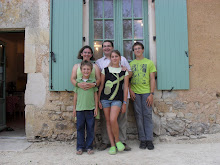
What happens when you move to a country where another language is used and your children are enrolled in a local primary of secondary school? Chances are high they'll pick up a few swearwords as they become bilingual. It's part of fitting in and sounding 'right'. But do you actually know any French swearwords? How do you know if the neighbour's child is just being silly or really insulting you? Which words should you ban your children using?
My lack of knowledge was highlighted when my sister gave my youngest child a set of washable pens to doodle on the bathroom tiles while in the bath. My two older children and their two French cousins 'borrowed' the pens and wrote French swearwords on the bathroom wall. I was furious because I was unable to deceipher the messages. The cousins sniggered that their English aunt was so naïve, and my children saw a chance to misbehave and say rude things to each other or me without being caught. Their punisment was to give me a basic grounding in gros mots, (or Ten Things Not To Say In Front Of Your Parents Or Teachers). Here are the results. They are listed in order of seriousness and vulgarity.
Dégage! – Get out of my way!/Get lost! (often used between kids)
Ferme ta geule! – Shut up!/Shut your gob! (rude)
Chiant – a pain/annoying/boring (mildly insulting)
Emmerdeur - nuisance/annoying (mildly insulting)
Imbécile/Cretin/Idiot – idiot (can be insulting)
Con/conard – stupid (offensive)
Salope/pétasse/pouffiasse – bitch (offensive)
Pute/Putain - slut/tart (offensive)
Merde! - s**t (offensive)
Je m’en fous! – I d'ont give a f**k! (offensive)
There are also some words which have become a 'lighter' alternative to an offensive word, like the way we say 'sugar' or 'shoot', in place of a stronger curse.
Punaise! – literally a 'drawing pin' or 'bedbug' (to replace putain)
Puree! - literally 'mashed potatoe' (to replace putain)
Mince! – literally 'slim' (to replace merde)
Je m’en fiche! I don’t give a damm! (cheeky)
For parents of children growing up in France I would recommend listening carefully to your children, particulary when they are talking to their friends. If you are not sure about new words ask your child's teacher, or a French friend to tell you which words are unacceptable for your children.
See also:
Titeuf - a cartoon character based on young adolescent who knows several gros mots (see comic books/dvds, available in all good bookshops)
http://www.wordreference.com
Useful dictionary website, which gives translations of colloquial French/English words and has an excellent forum for questions on language or swearing in context.
Thursday, May 06, 2010

Big Bad Words - Little Children
Young children love French 'naughty words' or gros mots...For bilingual English/French families living in France the most commonly heard are body words:
pipi (pee or wee-wee)
caca (poo)
zizi (willy)
fesse (bottom)
prout-prout (literally the sound of farting)
crotte de nez (snot)
crotte de chien (dog-poo).
caca-boudin (poo-black-pudding-sausage),
Beurk! means ‘yucky’, or a nasty smell or taste
Conjugating verbs like ‘to fart’ (péter) and ‘to burp’ (roter) are popular!
To insult each other young kids can say grosse vache or gros cochon (fat cow/pig).
pouet-pouet camembert is a silly phrase that young children say, something like 'na-na-ni-na-na' in English.
Words which your child should be careful of using in front of sensitive adults, neighbours and teachers are Dégage! (Get out of my way!), and Ferme ta geule! (Shut up!) Some words should be avoided, for example, cul (stronger word for bottom/arse), which can be considered vulgar, and con (stupid/idiot) is insulting.
If you are not sure about rude words your child is using do ask your child’s teacher or a French friend whether they think their vocabulary is suitable. Parents do need to be clear about the difference between ‘naughty’ words used between friends or in the playground, and words which should not be used in front of the teacher or adults
*See The Connexion newspaper (May 2010) for full version of swearwords for young children and Questions from parents about swearing.
http://www.connexionfrance.com/
See also:
http://www.dailymotion.com les-gros mots des- tout-petits (Titou le Lapinou)
A silly song about gros mots for little children.
http://www.wordreference.com
Useful dictionary website, which gives translations of colloquial French/English words with a forum for questions on language or gros mots.
‘Caca boudin’ by Stephanie Blake (5 €, www.ecoledesloisirs.fr)
A story in French for young children about a rabbit who likes the word caca-boudin…
pipi (pee or wee-wee)
caca (poo)
zizi (willy)
fesse (bottom)
prout-prout (literally the sound of farting)
crotte de nez (snot)
crotte de chien (dog-poo).
caca-boudin (poo-black-pudding-sausage),
Beurk! means ‘yucky’, or a nasty smell or taste
Conjugating verbs like ‘to fart’ (péter) and ‘to burp’ (roter) are popular!
To insult each other young kids can say grosse vache or gros cochon (fat cow/pig).
pouet-pouet camembert is a silly phrase that young children say, something like 'na-na-ni-na-na' in English.
Words which your child should be careful of using in front of sensitive adults, neighbours and teachers are Dégage! (Get out of my way!), and Ferme ta geule! (Shut up!) Some words should be avoided, for example, cul (stronger word for bottom/arse), which can be considered vulgar, and con (stupid/idiot) is insulting.
If you are not sure about rude words your child is using do ask your child’s teacher or a French friend whether they think their vocabulary is suitable. Parents do need to be clear about the difference between ‘naughty’ words used between friends or in the playground, and words which should not be used in front of the teacher or adults
*See The Connexion newspaper (May 2010) for full version of swearwords for young children and Questions from parents about swearing.
http://www.connexionfrance.com/
See also:
http://www.dailymotion.com les-gros mots des- tout-petits (Titou le Lapinou)
A silly song about gros mots for little children.
http://www.wordreference.com
Useful dictionary website, which gives translations of colloquial French/English words with a forum for questions on language or gros mots.
‘Caca boudin’ by Stephanie Blake (5 €, www.ecoledesloisirs.fr)
A story in French for young children about a rabbit who likes the word caca-boudin…
Sunday, March 14, 2010
Bringing Up Bilingual Children Talk (BEE Association) - 24 March 2010
I am presenting an informal talk on Family Bilingualism, organised by Victoria Turvey-Sauron from the BEE association, based in the Dordogne.
Date: Wednesday 24th March 2010
Venue: BEE Association, Roumagne, Lot-et-Garonne (47)
Cost: 3 euros BEE members/5 euros Non-members
Meeting Format: A presentation on bilingualism for one hour, followed by small group discussions on your experiences of bilingualism in France. The talk ends with your feeback from the discussions and time for questions.
If you have any questions on Family Bilingualism and schooling in France that you would like me discuss in the talk please email me(bilingsiblings@yahoo.com)before the talk. Please give me brief details of your family (how many children, their ages, languages spoken etc.)
I will also bring some books on bilingualism for you to browse and copies of my book Language Strategies for Bilingual Families will be available to purchase (12euros).
For more information go to the direct link on the BEE website: http://www.bilingual.fr/bilingual.html
BEE website: www.bilingual.fr
or via BEE on Facebook:
http://www.facebook.com/pages/Bilingual-Education-Exchange/316286696240?ref=mf
Thanks,
Suzanne Barron-Hauwaert
Email: bilingsiblings@yahoo.com
Date: Wednesday 24th March 2010
Venue: BEE Association, Roumagne, Lot-et-Garonne (47)
Cost: 3 euros BEE members/5 euros Non-members
Meeting Format: A presentation on bilingualism for one hour, followed by small group discussions on your experiences of bilingualism in France. The talk ends with your feeback from the discussions and time for questions.
If you have any questions on Family Bilingualism and schooling in France that you would like me discuss in the talk please email me(bilingsiblings@yahoo.com)before the talk. Please give me brief details of your family (how many children, their ages, languages spoken etc.)
I will also bring some books on bilingualism for you to browse and copies of my book Language Strategies for Bilingual Families will be available to purchase (12euros).
For more information go to the direct link on the BEE website: http://www.bilingual.fr/bilingual.html
BEE website: www.bilingual.fr
or via BEE on Facebook:
http://www.facebook.com/pages/Bilingual-Education-Exchange/316286696240?ref=mf
Thanks,
Suzanne Barron-Hauwaert
Email: bilingsiblings@yahoo.com
Tuesday, February 16, 2010
March 2 - Talk on Young Children & Bilingualism
Tuesday 2nd March - Accents Association Bilingual Talk
Speaker: Suzanne Barron-Hauwaert
Civray Grande Galerie, 10-12am
3 euros Accents members/5 euros non-members
This talk and discussion will focus on young children (from age 2 to 6 years) and the issues of early years schooling and bilingualism for English-speaking families in France. Parents are welcome with children in maternelle or those preparing for it. Proposed areas for discussion are:
Explanation of the French maternelle school program
Communicating with teachers & the cahier de communication
Parent-teacher meetings and grading of children
Language use in the classroom and playground
Gros mots or naughty words
French accents and sounding 'right'
Library books
Maintaining English at home
If you have any questions you would like me to answer please email me with brief history of your family (age of child, schooling etc.):
bilingsiblings@yahoo.com
You can also post ideas for the talk on the Accents Facebook page.
http://www.facebook.com/l/4cc77;www.accents-asso.fr
Speaker: Suzanne Barron-Hauwaert
Civray Grande Galerie, 10-12am
3 euros Accents members/5 euros non-members
This talk and discussion will focus on young children (from age 2 to 6 years) and the issues of early years schooling and bilingualism for English-speaking families in France. Parents are welcome with children in maternelle or those preparing for it. Proposed areas for discussion are:
Explanation of the French maternelle school program
Communicating with teachers & the cahier de communication
Parent-teacher meetings and grading of children
Language use in the classroom and playground
Gros mots or naughty words
French accents and sounding 'right'
Library books
Maintaining English at home
If you have any questions you would like me to answer please email me with brief history of your family (age of child, schooling etc.):
bilingsiblings@yahoo.com
You can also post ideas for the talk on the Accents Facebook page.
http://www.facebook.com/l/4cc77;www.accents-asso.fr
Tuesday, January 19, 2010
Feb 1st - Talk on Older Children and Bilingualism (English/French)
This talk and discussion will focus on older children (age 11+) and the issues of secondary schooling and bilingualism. Parents are welcome with children in secondary school or those preparing for it. Proposed areas for discussion are:
Explanation of the French secondary school program
Public versus private schooling?
Transition from primaire to collège
Being independent of parents
Homework
Parent's evenings and communicating with teachers
Increased need of specific vocabulary
Maths, History, Geography, Science: learning subjects in a 2nd language
'English is boring'
French is hard
A foreign language: German, Spanish, Latin
If you have any questions you would like me to answer please email me with brief history of your family (age of child, schooling etc.): bilingsiblings@yahoo.com
You can also post ideas for the talk on the Accents Facebook page.
http://www.facebook.com/l/4cc77;www.accents-asso.fr
Or leave a comment on my blog:
http://opol-family.blogspot.com/2010/01/feb-1st-talk-in-older-children-and.html
Suzanne Barron-Hauwaert
Explanation of the French secondary school program
Public versus private schooling?
Transition from primaire to collège
Being independent of parents
Homework
Parent's evenings and communicating with teachers
Increased need of specific vocabulary
Maths, History, Geography, Science: learning subjects in a 2nd language
'English is boring'
French is hard
A foreign language: German, Spanish, Latin
If you have any questions you would like me to answer please email me with brief history of your family (age of child, schooling etc.): bilingsiblings@yahoo.com
You can also post ideas for the talk on the Accents Facebook page.
http://www.facebook.com/l/4cc77;www.accents-asso.fr
Or leave a comment on my blog:
http://opol-family.blogspot.com/2010/01/feb-1st-talk-in-older-children-and.html
Suzanne Barron-Hauwaert
Wednesday, January 06, 2010
2010
Best wishes for the New Year!
The Accents Association will be hosting a series of monthly talks this year, in an informal setting parents and educators can discuss issues relating to French/English bilingual children and their families. Specific subjects that were requested in the talk in December are:
- Teenagers and maintaining bilingualism.
- Primary school and bilingualism.
- Pre-school and the first steps towards bilingualism.
The first meeting of 2010 is planned for MONDAY 1st February in the Chef-Boutonne area.
For more information contact Kathryn:
http://www.accents-asso.fr/
AccentsAdmin@orange.fr
Tel: 05 49 97 10 17
The Accents Association will be hosting a series of monthly talks this year, in an informal setting parents and educators can discuss issues relating to French/English bilingual children and their families. Specific subjects that were requested in the talk in December are:
- Teenagers and maintaining bilingualism.
- Primary school and bilingualism.
- Pre-school and the first steps towards bilingualism.
The first meeting of 2010 is planned for MONDAY 1st February in the Chef-Boutonne area.
For more information contact Kathryn:
http://www.accents-asso.fr/
AccentsAdmin@orange.fr
Tel: 05 49 97 10 17
Tuesday, December 22, 2009


Subscribe to:
Posts (Atom)