Tuesday, December 08, 2009

A little bit of family news...


As 2010 rolls in I am amazed how quick time flies and how history seems to go in circles. The decade started in rural France, at Jacques' parents house, with the heavy storms of the end of December 1999 and no electricity for a week. Then we had two young children under the age of two. We end the decade living in rural France, via England, Malaysia, America, with three children. Marc, our 12 year-old growing-up-fast-almost-teenager, Nina, our 10-year-old pre-teen chatterbox and Gabriel, the angelic, but lively six-year-old. Along the way we gained a cat, rabbit and fish too.

So what happened in 2009? In autumn Jacques started working from home, which is good for us all and less travelling for him. Marc is growing (now taller than me, 158cm and stil going) and still likes tractors, Nina is in her last year of primary school, she likes music and horse-riding and Gabriel has just learnt to read and play football. The children are more-or-less bilingual and manage to juggle two cultures and languages effortlessly. I finally got the draft done of my book on Siblings and have been busy writing for 'The Connexion' (an English-language newspaper published in France) and teaching English locally.

We all enjoyed our annual family trip to ski (this year in La Plagne). Our holidays were linked to visiting friends this year around the world. Our visits to Munich (Mickeal), Thailand (Mahes), Kuala Lumpur for John's wedding (Odile, Hilary, Mahin, Marie-Cecile, Victoria, Mahin, Nilgoun, Aimee and many others) and Scotland (Corinne, Marie). These were places we had been before, but we saw in a new light. We had a lot of friends and family visit us too this year, you are always welcome in deepest rural France!!

Hopefully, next year we will move down the road to the Logis, which is progressing. The 'heavy' work has been done. It has floors now, a new roof, new windows and full insulation. We have started a vegetable garden this year and are planting a mixed fruit/trees hedge (650 trees) around the property.(see post 'Photos 2009'below for some recent photos) Like all renovation projects the Logis needs lots of money and takes more time than predicted but we do still plan to move there in 2010, in time for Jacques' 40th birthday....

Do keep in touch.

Suzanne

2009 photos


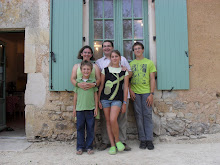
The Logis Vert (back view and front, with steps) and us on holiday in breezy Scotland this summer.

Thursday, November 19, 2009

Accents talk in Ruffec

I am presenting an informal talk on Family Bilingualism, organised by Kathryn Dobson from the Accents Association. If you would like to attend please confim with Kathryn: accentsadmin@orange.fr before the 23rd November.

Date: Tuesday 1st December

Venue: Seppings Café (Condac near Ruffec - about 5 mins off the N10)

Leader: Suzanne Barron-Hauwaert

Cost: If you would like to join us for lunch (recommended) then the cost will be 12€ per head (includes coffees/teas etc.) - please let us know if you would like the vegetarian option. If you would like to just come for the meeting there will be a charge of 3€ to cover coffees/teas etc. but we do need at least 10 having lunch to have free use of the venue.

Meeting Format:

We will start with a presentation on bilingualism and then have a general discussion for the second hour. If you have any specific areas that you want to discuss (starting out, issues, one parent one language etc.) then just let us know.

I will bring some books on bilingualism for you to browse and copies my my book (Language Strategies for Bilingual Families) will be on available to purchase.

You can email me your questions on Bilingualism and schooling in France to me at:

bilingsiblings@yahoo.com

or reply through this blog.

Please give me brief details of your family (how many children, their ages, languages spoken.)

Thanks,

Suzanne Barron-Hauwaert

Monday, November 02, 2009

One-cat-one-language


Our cat, Caline, is two years old now. As we celebrated her birthday we tried out some IQ tests to see how she was doing. The children set up a timed test.
‘Caline, here’s your dinner!’ (Cat runs across room and eats food one minute later)
Caline, vien manger ton dîner!’ (Cat runs across room and eats food two minutes later)
They decide she replies faster to English, probably because four of us always speak English to her. It seemed weird to speak my second language to an animal, and the children simply followed suit, even though she joined our household as a six-month-old kitten from a French family. The cat does have a role to play though. She is a shining example of the one cat-one language strategy, because now Marc, Nina and Gabriel all speak English to the cat. She meows in return and conversations can go on for quite some time. They even made up special songs for her.

My French friend, Corinne, lives in Scotland and just adopted a kitten from a French family who were moving home. Her two children also follow the one-cat-one-language policy and only talk in French to the cat. Corinne is happy to hear them using more of her language and reports that the kitten loves the kids chatting to her. The OCOL approach may not be high level language use, being rather limited in subject matter (food, water, mice, birds, the weather), but at least it gives children a chance to use the minority language with a willing and purring listener.

Game on!

Family games are a traditional way to bring parents and children together, with timeless classics. However, in the OPOL family games like Monopoly can have two meanings. For me, the cards represent my British childhood (Park Lane, Trafalger Square), while Jacques’ has a more chic version (Champs Elysées, Rue de la Paix). The children have played both versions and, frankly, they prefer the French one, for the practical reason that their French cousins and friends can play too. Marc and Nina said they got sick of explaining the value and cultural meaning of London property sites, and dealing in pounds when they could use euros.

Never agree to play Trivial Pursuit in your second language, unless you have a degree in the History and Culture of the language. At a recent village Games Night I naively joined the Trivial Pursuit table, thinking I could easily score some points for my team. But the only question I could answer was ‘Which three languages are spoken in Luxembourg?’ Otherwise, fifty classic French culture, people, sport and music questions passed straight over my head. It was humiliating. Bingo is a simple game of cards and numbers that any person can play and is popular in the villages in winter. But what if half the family has problems with French numbers over sixty? (That’s me and Gabriel, by the way). While the others coolly serve themselves drinks I desperately try to find ‘quatre-vingt-douze’ (20 x 4 +12, or 92). And when I finally fill in all the gaps do I shout ‘Bingo!’ or ‘Loto!’?

On the early evening family television game shows we watch together Nina is quick to fill in the blanks in the French version of ‘Wheel of Fortune’, while I am still working out what the question meant in the first place. In the French version of ‘Who wants to be a Millionaire?’ I can only answer those trick questions designed to catch the French out, like what is the name of the famous clock in London a) Big Mac, b) Big John, c) Big Ben or d) Big Boy? ‘Yes!’ I shout ‘I know that one. It’s c!!’ as the children groan and say everyone knows that answer.

A classic drawing game, Pictionary, should be transferable across cultures. A recent game of with a group of French-English bilingual children showed a technical problem with languages. The word was ‘Seal’. One child scribbled a drawing and one team yelled ‘Seal!’ as the others screamed ‘Phoque!’ simultaneously. This particular French word is banned in our house (after Marc once said to my mum while watching a nature programme, ‘Oh, look, a phoque…’). As referee I disqualified the team who said the bad word. They cried injustice and argued that any word in any language could be used and the rules do not state which language the game must be played in. ‘You have to choose one language,’ I say, ‘It would create total chaos if we all spoke three or four different languages.’ The children disagree and decide to take me to the European Court of Human Rights for inhumanity towards bilinguals…

Wednesday, July 15, 2009

Mummy-talk in a Second Language

Jacques and I were brought up in villages and our childhoods were very simple. You either played in your own garden with your siblings or popped round to play with other kids. You could stay for tea and no-one would bother, and you went home when it was getting late. But thirty years on all that has changed and playing with other kids is timetabled, along with the other after-school activities. You therefore need to ‘network’ other class mothers and work out what day their children are free. I have had to do a crash course in ‘second-language-mummy-talk’ to get by.

The French mothers don’t know anything about me (they are very curious) and on the first official get-together I have to go through the whole thing in French…. where I am from, where we live now, how many kids we have, which class and teacher, why I put kids in French school, what my husband does and even where we are going for the next holiday. When I have got through all that there is the confidential mummy chat….what do you really think about the teacher and have you heard about so-and-so who had an affair…. After emerging from the home a French neighbor, who offered me a coffee when I arrived to pick up Gabriel and interrogated me for 40 minutes, I felt like I was 16 again and taking my oral exam in French. I just need a certificate in ‘mummy-talk’ now!

AZERTY or QWERTY?

With a newly installed wifi system at home the children can use a spare computer downstairs. I hope that having more access to the internet might inspire them to read and write more in English. But we discover that having two languages can sometimes complicate computer literacy. Marc and Nina ask for email accounts, and I register them with same free email provider as me. But no, they don’t want the English-language version, they want the French one. So we sign on with the French language network. We need to create a username. Marc, follows the French pattern, where surnames come first, and chooses ‘hauwaertmarc’, while Nina goes for the other way round ‘ninahauwaert’. Secret passwords are the next step. Marc chooses an English word, saying that no French person would guess it. Nina picks her rabbit’s birthday. I tap the passwords in and ask them to re-type them. There’s a brief glitch as Nina retypes French ‘mai’ instead of my English ‘May’. ‘Does it matter?’ says bilingual Nina, ‘It’s the same word.’ The computer disagrees with her and says no.

I sit with them as they write their first email, but the instructions in the French email inbox are totally unfamiliar for me, supprimer, brouillon….the only word I recognize is poubelle (trash). I feel out of my depth since it barely resembles my email inbox. We struggle along setting up the address book. Marc dictates an address saying jeanlucarrobayahoo.fr, which makes no sense to me and I write Jean Luc Arroba twice until I realize that arroba means the @ sign in French. We try to compose a brief message to my dad in England. Then we hit another problem. They use AZERTY keyboards at school, but we have a QWERTY one at home.

Marc and Nina are painfully slow with the QWERTY one, desperately searching for the full-stop, exclamation and question marks, which have mysteriously ‘moved’ and shouting, ‘Mummy, there’s no A on your computer!’ Their typing skills are so horrifically bad even my spellchecker goes on strike and asks if I want to install a French one. Left to their own devices they prefer phonetic spellings or text abbreviations. My dad nearly got “How R U? Im OK. Skool gud.’ After a frustrating half hour composing an email they tell me that emailing is boring, and I should set up Skype so they can chat to Grandpa via the computer. Even if emails are not for them, they can surf and flick from site to site with speed. I admire them googling sets of keywords in French and English, comfortable and confident in either linguistic zone.