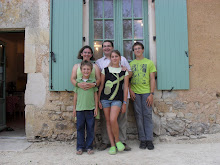
A new group of friends had formed around New Year. In Marc’s class a new girl called Eva had arrived. Eva was half Scottish and half-French, her father worked as a top pastry chef in the Hilton. Nina had made friends with a new girl in her class, Elodie, who was a beautiful mix of Phillipino mother and French father, who also worked as a top pastry chef at the Shanghri-La hotel in KL. Thinking they would have something in common I introduced Scottish Hilary and Phillipino Maribeth to each other at a school event.
Maribeth then introduced us to Youssy, an Indonesian woman also married to a French pastry chef, with a boy in maternelle. Maribeth was studying French with Sasi (or Mem) a Thai lady married, naturally, to a Frenchman, who had a boy in Nina’s class. We then met Yuen-chi, who had been one of the Vietnamese boat-people as a child and lived in Canada, married to a Frenchman and had a daughter the same age as Nina and Elodie. Our last member of the group was Audrey, who was a Chinese heritage Malaysian with French hubby and a daughter a year younger than Nina in the French school.
Although it was a diverse mix, Scottish, English, Phillipino, Indonesian, Thai, Malaysian and Vietnamese/Canadian, we bonded quickly. They had all lived abroad before in places as diverse as Dubai, Korea or America, and we usually moved every two years so we knew we must make friends fast before time ran out. Very quickly the group became a regular weekly fixture. We began having coffee together and comparing notes on our class teachers and the French school. Once a month we would eat at one of our houses, Maribeth was famous for her spring rolls, Sasi her spicy soups or I would make a quiche and salad. The group then graduated to sampling the posh hotel lunch buffets (with discount because the father worked there), or meting up in twos or threes to try out local Thai, Japanese or Malaysian restaurants. We even did Girls Night Outs, sipping cocktails or watching a band in the hotels.
We had a certain camaraderie, a safety in numbers against the stuck-up French-French families, that we all disliked, and we would welcome each other with smiles at the school gates. At school events it was wonderful to arrive at a class show or cultural event and find one of the group had saved me a seat. Six or eight people seems to be the ideal number for a group, and we could pair off or meet as a trio without any rivalry or hurt feelings. Although I felt closest to Hilary in character, I enjoyed greatly Sasi and Maribeth’s company.
However there were certain days when I felt split between my group and making efforts with the French. At one class coffee morning the maman’s split linguistically. I was in the middle, torn between talking in English (to Sasi and Maribeth and Yuen-Chi) or speaking French to the French mothers. We all had a few French friends through our children, and we took pride in them and tried hard to maintain contacts with ‘Friendly French’. However in a crisis we knew who to turn too. We were there for each other, when we felt homesick or when we didn’t understand the homework, when our kids got bad reports or our French husbands drove us crazy!
Wednesday, April 25, 2007

Friday, March 30, 2007
Bali and the tsunami

The year ended with a Christmas trip to Bali. It was quieter than it should have been after the terrible terrorist bombings. Hotels stood empty and the beach was full of women trying to sell massages or sarongs. We had a fantastic Christmas day in our resort, with Santa surfing in on the waves and delivering gifts for all the children. On Christmas Day, which is also my birthday, there was a show that our children performed in and Marc stood up and asked if he could sing happy birthday to me, and everyone sang along, as I blushed bright red on the stage!
The next morning we heard on the BBC news that there had been an earthquake and saw first reports from Sri Lanka. After we returned from a snorkeling trip later on we realized the enormity of the situation as reporters spoke of a tsunami hitting the north of Indonesia, Phuket, where we had been just a year ago, and some parts of Malaysia. We imagined what our families must be thinking and quickly called to reassure them. Prayers were said and clothes and money collected for the refugees. We spent New Year in the small town of Ubud, the atmosphere was solemn and the tourists walked quietly as if not to upset the locals. It felt like something had unleashed the god's fury and the Balinese loaded their shrines with fruit and incencse to appease the angry spirits.
Three days later we were sat on the beach and Jacques' cell phone rang. It was the French embassy in KL. They wanted to know if we were all ok. Jacques asked if they were calling all the French expats. ‘Oh no!’ The lady replied, ‘You have been reported missing by your neighbours…’ Then the line went dead. We flew back in to find all our neighbours waiting for us. One had been sure we had gone to Phuket, like we did last year, and no-one could really say for sure if it was Phuket or Bali, in the middle of Christmas shopping they had not really had time to ask specific questions. The Algerian diplomat had phoned the French embassy on our behalf. We were very touched by their kindness, but saddened to hear that a new family in the condo from South America had cancelled their last-minute trip to Langkawi and flew into Phuket the day it happened. Luckily they were on the fourth floor and survived although seeing the carnage on the beach shocked their nine-year-old daughter terribly.
Thursday, March 29, 2007
A book, a talk and a visitor
My book was published in May 2004 and I had a talk booked at the international mothers group, ibu, for the beginning of November in a local bookshop. My father was visiting and brought over some extra copies of the book. It was on a Tuesday, a busy day for coffee mornings and activities, so I was expecting a small crowd, but more and more women arrived and in the end there were about twenty. I was nervous and it was hard to distil a book into a thirty-minute lecture. I explained the seven strategies and the types of child bilingualism. It sounded rather boring and more like a university talk and the all looked rather sleepy, so I concluded earlier than planned and asked if anyone had any questions.
That opened a floodgate of queries, comments and discussion. It was a wonderfully mixed crowd, some Malaysians women married to foreigners, and several expat English, Dutch, German, French and Australians curious to know more, or who wished to bring up their children bilingually after seeing the success Malaysians have had. We discussed schooling, parenting and how to have more input in the weaker language. At the end I sold four books and promised to start a monthly group in the new year, so we could meet regularly and discuss more. It seemed they wanted to talk and share advice and experiences. After Dad and I went to celebrate with lunch at a local Japanese restaurant in Sri Hartamas.
Grandpa stayed two weeks in KL with us. He was bitten badly by mosquitos but apart from that loved Malaysia. He adventurously tried reflexology, rode on an elephant at the sanctuary, climbed over a hundred steps to visit the Hindu Batu caves temple and sampled all the cultural foods he could. The kids loved having him around and after school would rush to tell him about their day. One evening I found him reading through Marc’s French homework with him, I was touched because it must have been rather disorientating to see the children studying in French rather than English, and although he might not have understood everything he was making an effort and that’s what matters in the end.
That opened a floodgate of queries, comments and discussion. It was a wonderfully mixed crowd, some Malaysians women married to foreigners, and several expat English, Dutch, German, French and Australians curious to know more, or who wished to bring up their children bilingually after seeing the success Malaysians have had. We discussed schooling, parenting and how to have more input in the weaker language. At the end I sold four books and promised to start a monthly group in the new year, so we could meet regularly and discuss more. It seemed they wanted to talk and share advice and experiences. After Dad and I went to celebrate with lunch at a local Japanese restaurant in Sri Hartamas.
Grandpa stayed two weeks in KL with us. He was bitten badly by mosquitos but apart from that loved Malaysia. He adventurously tried reflexology, rode on an elephant at the sanctuary, climbed over a hundred steps to visit the Hindu Batu caves temple and sampled all the cultural foods he could. The kids loved having him around and after school would rush to tell him about their day. One evening I found him reading through Marc’s French homework with him, I was touched because it must have been rather disorientating to see the children studying in French rather than English, and although he might not have understood everything he was making an effort and that’s what matters in the end.
Tuesday, March 27, 2007
Love and war at school
School restarted in September and Nina got lucky though with a newly arrived teacher, Delphine. Nina was now in the top class of maternelle, or Grand section, and absolutely loved school. Within a few weeks she had fallen in love with a new boy in the class, Dorian. He was trilingual and had a Spanish-speaking mother, Gina, who was married to a French man and Dorian had attended English school before starting at the French school. When Delphine put on a class show displaying folk dances and Nina and Dorian danced together like Ginger and Fred.
Dorian became a frequent companion on trips to the park or museums, gallantly buying Nina an orange juice in the café one time and bringing her a pink silk scarf from a trip to Paris. Unfortunately Dorian played more with Marc when he came to our house, and the two boys would sneak off together to ride bikes or play in the pool, leaving sulky Nina all on her own. One weekend he invited himself for a sleepover, and Marc and Nina fought to have him in their rooms. In the end he bunked with Marc. But after a few months Dorian declared his undying love for two other pretty girls in the class. When asked which one he would marry he announced that he would marry all three, like some of Muslims do in certain parts of Malaysia. Nina was horrified and refused to share him, and dropped him like a hot stone.
Marc was in CM1, with the same teacher who taught Nina when we first arrived in 2003. I had not got on with Madame Chapeau then and it didn’t seem like this would be a good year for Marc either. I met the teacher in the playground one day after school just after the year had started. I bonjoured her, as one does and she replied ‘Hello’. I asked in French ‘Is everything OK with Marc’ and she replied ‘He is mixing up his English with his French’. The conversation continued with me speaking French and her replying in English, as though she didn’t understand my French. I was furious.
A few weeks later Marc had a punition, or a punishment, and had to write ‘Je n’ai pas droit de parler en anglais en classe’ (I am not allowed to speak English in class) fifty times, because he had spoken English to his friend, Adam, in class. Marc told me she often punished children who chatted in English in class. It was a problem because about half the class was bilingual and although they could speak French they chose not too, which annoyed Madame Chapeau even more. At the class talk for parents I found her aggressive and often rude to parents, but she was friendly with several influential parents and teachers and I knew if I complained to higher powers it would get me nowhere. But I disliked her nevertheless…
On top of this Marc’s English marks plummeted and I had to talk to the English teacher, a French woman. She explained how she had two levels: ‘just arrived in KL beginners’ and ‘bilinguals, those who have a foreign parent or have lived here a long time’. She preferred teaching the beginners. I got the distinct impression she was sick of all the annoying bored bilinguals who could talk the hind legs off a donkey but had terrible grammar. She said Marc spent his hour making paper aeroplanes or scribbling messy stories that she couldn’t read. I tried to talk to Marc, who didn’t care at all about his English grades, and said that English lessons were ‘nul’ or worth nothing anyway….
Dorian became a frequent companion on trips to the park or museums, gallantly buying Nina an orange juice in the café one time and bringing her a pink silk scarf from a trip to Paris. Unfortunately Dorian played more with Marc when he came to our house, and the two boys would sneak off together to ride bikes or play in the pool, leaving sulky Nina all on her own. One weekend he invited himself for a sleepover, and Marc and Nina fought to have him in their rooms. In the end he bunked with Marc. But after a few months Dorian declared his undying love for two other pretty girls in the class. When asked which one he would marry he announced that he would marry all three, like some of Muslims do in certain parts of Malaysia. Nina was horrified and refused to share him, and dropped him like a hot stone.
Marc was in CM1, with the same teacher who taught Nina when we first arrived in 2003. I had not got on with Madame Chapeau then and it didn’t seem like this would be a good year for Marc either. I met the teacher in the playground one day after school just after the year had started. I bonjoured her, as one does and she replied ‘Hello’. I asked in French ‘Is everything OK with Marc’ and she replied ‘He is mixing up his English with his French’. The conversation continued with me speaking French and her replying in English, as though she didn’t understand my French. I was furious.
A few weeks later Marc had a punition, or a punishment, and had to write ‘Je n’ai pas droit de parler en anglais en classe’ (I am not allowed to speak English in class) fifty times, because he had spoken English to his friend, Adam, in class. Marc told me she often punished children who chatted in English in class. It was a problem because about half the class was bilingual and although they could speak French they chose not too, which annoyed Madame Chapeau even more. At the class talk for parents I found her aggressive and often rude to parents, but she was friendly with several influential parents and teachers and I knew if I complained to higher powers it would get me nowhere. But I disliked her nevertheless…
On top of this Marc’s English marks plummeted and I had to talk to the English teacher, a French woman. She explained how she had two levels: ‘just arrived in KL beginners’ and ‘bilinguals, those who have a foreign parent or have lived here a long time’. She preferred teaching the beginners. I got the distinct impression she was sick of all the annoying bored bilinguals who could talk the hind legs off a donkey but had terrible grammar. She said Marc spent his hour making paper aeroplanes or scribbling messy stories that she couldn’t read. I tried to talk to Marc, who didn’t care at all about his English grades, and said that English lessons were ‘nul’ or worth nothing anyway….
Monday, March 26, 2007
Aimee goes to France
Jacques decided not to go to France for the summer holiday, but I desperately wanted to see the family and Jacques mother had booked two weeks holiday with Marc, Nina and three cousins. I didn’t want to leave our maid, Aimee, alone for six weeks with nothing to do, and Jacques thought she could help his parents, prepare the meals and accompany Jacques' mother on the holiday. It would be helpful to have a traveling partner especially with a lively 18-month old toddler. I thought Aimee might enjoy seeing France and I promised to take her up the Eiffel Tower in Paris. I had to do all the paperwork at the French embassy, where I bumped into two school mothers who were also taking their maids back to France. They assured me it always went well and their maids were happy to travel. Finally after much packing and gift buying we boarded a night flight for Paris via Dubai.
We finally arrived in Paris around lunchtime. Usually we took the direct flight and could catch an early morning train from the airport, but we had to take a bus into the centre to Gare Montparnasse. Our bags weighed a ton, the kids were grumpy, Aimee was jet-lagged and disorientated and I felt like I had four children. We were so slow that we nearly missed the train and ended up sat in the corridor on our bags, because our reserved seats were the other end of the train and you could not pass through. Aimee must have wondered what on earth was France like. When we arrived at Poitiers, looking disheveled and giggling with over-tiredness I was truly wondering if I had done the right thing. But when we arrived at the house in Pouillox everyone was waiting for us. In the sunny courtyard Jacques’ mother had prepared trays of cool drinks, tiny jam and lemon tarts and savoury snacks. It was heaven. The cousins re-established their friendship instantly and Gabriel was admired and cooed over and Aimee met everyone.
Aimee adapted very well to France and although she didn’t speak French she always managed to second guess what was needed. Aimee did not like the cold mornings though and didn’t own any warm clothes. Odile dug out a bag of secondhand clothes and we managed to kit Aimee out. Coming from a large family Aimee told me she liked having so many people around. She made her speciality fried rice and spring rolls, and fussed over the cousins, plaiting their hair and playing with them.
Only one time did she feel out of place. At the end of the holiday we went camping with Gaelle and the cousins at the beach. Aimee had never slept in a tent and was curious why all these rich people were sleeping outdoors when they could have gone in a nice hotel, or barbecuing sausages and washing their dishes under the tap when they could have gone to a restaurant? The beaches were crowded that year, so Gaelle and I decided to go to the plage naturist or nudist beach, where it was easy to find a space and the kids could run around without their swimsuits.
Aimee was horrified and shocked to see nude men and topless women, and looking at it from her eyes I was too, especially after coming from Malaysia where nudism is not at all tolerated, and Muslim female bathers wear suits that cover everything but their feet and hands. I told Aimee that I wouldn’t strip off, it was really for the kids to have more space. But Aimee sat fully clothed and uncomfortable under the parasol until we left. After that we either went to the usual busy beach or left her behind in the campsite.
At the end I took the kids and Aimee to Paris for a few days. We did all the tourist things and went to Disneyland for the day. She said it was much better than she imagined. It was her birthday as we flew back to Malaysia via Dubai, and the kids joked that she had her birthday in three continents; Europe, Middle East and Asia. Odile and I had given her some euros to spend in duty-free at the airport, and she came back with a huge bottle of Estee Lauder perfume, which she said would remind her of France.
We finally arrived in Paris around lunchtime. Usually we took the direct flight and could catch an early morning train from the airport, but we had to take a bus into the centre to Gare Montparnasse. Our bags weighed a ton, the kids were grumpy, Aimee was jet-lagged and disorientated and I felt like I had four children. We were so slow that we nearly missed the train and ended up sat in the corridor on our bags, because our reserved seats were the other end of the train and you could not pass through. Aimee must have wondered what on earth was France like. When we arrived at Poitiers, looking disheveled and giggling with over-tiredness I was truly wondering if I had done the right thing. But when we arrived at the house in Pouillox everyone was waiting for us. In the sunny courtyard Jacques’ mother had prepared trays of cool drinks, tiny jam and lemon tarts and savoury snacks. It was heaven. The cousins re-established their friendship instantly and Gabriel was admired and cooed over and Aimee met everyone.
Aimee adapted very well to France and although she didn’t speak French she always managed to second guess what was needed. Aimee did not like the cold mornings though and didn’t own any warm clothes. Odile dug out a bag of secondhand clothes and we managed to kit Aimee out. Coming from a large family Aimee told me she liked having so many people around. She made her speciality fried rice and spring rolls, and fussed over the cousins, plaiting their hair and playing with them.
Only one time did she feel out of place. At the end of the holiday we went camping with Gaelle and the cousins at the beach. Aimee had never slept in a tent and was curious why all these rich people were sleeping outdoors when they could have gone in a nice hotel, or barbecuing sausages and washing their dishes under the tap when they could have gone to a restaurant? The beaches were crowded that year, so Gaelle and I decided to go to the plage naturist or nudist beach, where it was easy to find a space and the kids could run around without their swimsuits.
Aimee was horrified and shocked to see nude men and topless women, and looking at it from her eyes I was too, especially after coming from Malaysia where nudism is not at all tolerated, and Muslim female bathers wear suits that cover everything but their feet and hands. I told Aimee that I wouldn’t strip off, it was really for the kids to have more space. But Aimee sat fully clothed and uncomfortable under the parasol until we left. After that we either went to the usual busy beach or left her behind in the campsite.
At the end I took the kids and Aimee to Paris for a few days. We did all the tourist things and went to Disneyland for the day. She said it was much better than she imagined. It was her birthday as we flew back to Malaysia via Dubai, and the kids joked that she had her birthday in three continents; Europe, Middle East and Asia. Odile and I had given her some euros to spend in duty-free at the airport, and she came back with a huge bottle of Estee Lauder perfume, which she said would remind her of France.
Friday, March 23, 2007
The Four Years theory
We had a few goodbye parties to attend in June, our condo Chinese-American neighbour, Min and her family, were posted to Vietnam after seven years in KL, and Nina’s French/English friend, Isolde, was transferring to the British school to join her older sister. Nina’s teacher, Therese, was going back to France. At a goodbye potluck dinner organized by Nina’s class rep for the teacher the mothers chatted about leaving and how much longer they had to go. It sounded like a prison sentence… ‘I’ve got two, maybe three years, if we’re lucky…’, ‘This is our first year and I hope we get sent back next year...’ ‘We’ve been here six years and it’s too long, I hate KL now…’ or the new arrival: ‘I could stay here forever I love it!’ Therese had lived in KL for five years and was dreading the return to a tiny apartment in Paris. She was adored by parents and children and was tearful when accepting her goodbye gift of a painting by a local artist and said she would never have such a great class or life again. She was probably right.
Parents finally came to the conclusion that four years was the idea posting; one or two years were too short to really settle or find friends, but once you had done five years it was truly painful to leave or you became bitter and stopped enjoying Asia and all its chaos. The mothers agreed that we all got so used to our maids, not having to work, the lively social life and the year round sunshine that after a while it seemed impossible to go back to where you came from. It was even worse if your children were born in the country and had lived most of their childhood there, since it was all they had ever known. Parents felt terribly guilty moving their children around the world, although many had no choice and when the husband was called up off they went. Some of the English families I had met had been living abroad for years and never intended to go back if they could help it. However the French often seemed to do a short two-year posting then back to France for a while, then out again somewhere else.
We had never spent more than two years in one place anyway, which would probably explain why we were never really attached to any country. Four years sounded just right to me, enough time to get to know lots of people, feel at home in the city, to know just where to get a certain fabric or ingredient and enough time to learn something new.
Parents finally came to the conclusion that four years was the idea posting; one or two years were too short to really settle or find friends, but once you had done five years it was truly painful to leave or you became bitter and stopped enjoying Asia and all its chaos. The mothers agreed that we all got so used to our maids, not having to work, the lively social life and the year round sunshine that after a while it seemed impossible to go back to where you came from. It was even worse if your children were born in the country and had lived most of their childhood there, since it was all they had ever known. Parents felt terribly guilty moving their children around the world, although many had no choice and when the husband was called up off they went. Some of the English families I had met had been living abroad for years and never intended to go back if they could help it. However the French often seemed to do a short two-year posting then back to France for a while, then out again somewhere else.
We had never spent more than two years in one place anyway, which would probably explain why we were never really attached to any country. Four years sounded just right to me, enough time to get to know lots of people, feel at home in the city, to know just where to get a certain fabric or ingredient and enough time to learn something new.
Wednesday, March 21, 2007
Livret Scholaire
The school year ended and final reports were sent out. This was Marc and Nina’s first major one, and I hadn’t realized it would be undecipherable. After spending an hour trying to decode the document I ask my French-speaking Algerian neighbour, Soraya, for help. She points out the important lines, and assures me that all is well if Marc is going up to the next class. The Livert Scolaire or school book is organized in cycles, Cycle 1 is the maternelle or pre-school classes – petit, moyen and grand, going up to the year when the child is six. Cycle 2 is the following three years - CP/CE1 and CE2, taking the child up to age nine.
Marc and Nina’s report are graded : A reports compétence acquise, B denotes compétence en cours normal d’acquisition, C is compétence à renforcer and D signals compétence non encore acquise. An A means you got it, B shows that the competence in the subject is developing normally, a C asks that the understanding is reinforced and a D is not yet understood. Marc has an even sprinkle of A, B and C’s. Thankfully there are no D’s. Maths seems to be his best subject. French his worst and the comments state that his English is ‘interfering’ with his reading and writing. Nina has mainly ‘acquired’ what she should have and scores high on oral languages, except for some issues with sound recognition and articulation. Marc is not paying attention in his English classes (boredom maybe?) while Nina is an chatty and active participant.
The seven-page document lists every possible testable item on the curriculum from sport, singing to class attitude and autonomy. Some items I simply did not understand, like these examples from the French language section: ‘sait utiliser le classement de BCD.’, ‘distingue dans la phrase simple le GNS du GV.’ Grammar figures highly, there are several paragraphs about verbs, conjugation and vocabulary. There are some areas that I find particular French; the ability to speak ‘correctly’, to logically organize thoughts, and to write perfectly, that is, within the lines, respecting the margin, spaces and connecting letters. This would be asking too much of an English child of the same age, who is just beginning to do joined-up writing...never mind speaking correctly.
I read through the book amazed at the things Marc and Nina should have learnt. In panic I turn to the last page and see the phrase ‘passage a CE1’ and ‘passage a GS’ .Yes! Marc and Nina have made it to the next class! But there is also the sobering thought that the work will get harder and Marc certainly will have keep up with the class…. and somewhere along the line I am going to have do a crash course in French grammar or how can I ever help him?
Marc and Nina’s report are graded : A reports compétence acquise, B denotes compétence en cours normal d’acquisition, C is compétence à renforcer and D signals compétence non encore acquise. An A means you got it, B shows that the competence in the subject is developing normally, a C asks that the understanding is reinforced and a D is not yet understood. Marc has an even sprinkle of A, B and C’s. Thankfully there are no D’s. Maths seems to be his best subject. French his worst and the comments state that his English is ‘interfering’ with his reading and writing. Nina has mainly ‘acquired’ what she should have and scores high on oral languages, except for some issues with sound recognition and articulation. Marc is not paying attention in his English classes (boredom maybe?) while Nina is an chatty and active participant.
The seven-page document lists every possible testable item on the curriculum from sport, singing to class attitude and autonomy. Some items I simply did not understand, like these examples from the French language section: ‘sait utiliser le classement de BCD.’, ‘distingue dans la phrase simple le GNS du GV.’ Grammar figures highly, there are several paragraphs about verbs, conjugation and vocabulary. There are some areas that I find particular French; the ability to speak ‘correctly’, to logically organize thoughts, and to write perfectly, that is, within the lines, respecting the margin, spaces and connecting letters. This would be asking too much of an English child of the same age, who is just beginning to do joined-up writing...never mind speaking correctly.
I read through the book amazed at the things Marc and Nina should have learnt. In panic I turn to the last page and see the phrase ‘passage a CE1’ and ‘passage a GS’ .Yes! Marc and Nina have made it to the next class! But there is also the sobering thought that the work will get harder and Marc certainly will have keep up with the class…. and somewhere along the line I am going to have do a crash course in French grammar or how can I ever help him?
Subscribe to:
Posts (Atom)